
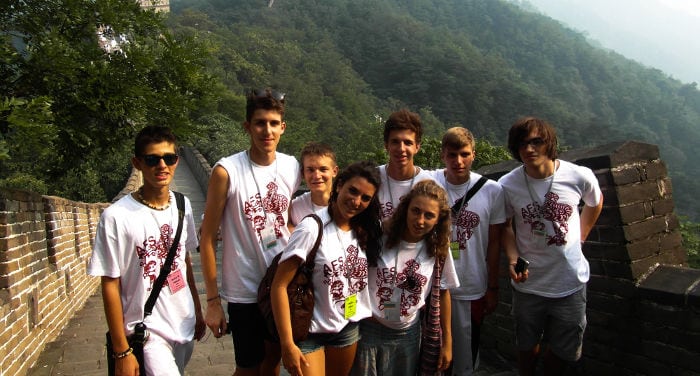
 At the Chinese Great Wall (Marta is on the right side, in the foreground).
Anatomy of an interview
At the end of November I received the following email:
Hey,
I’m Marta, I’m almost seventeen and this year I live in Nanjing, I study in a Chinese high-school, I have a Chinese mom and sister (I mean, they host me at their house), I live the life and follow the rules of a traditional Chinese adolescent.
When I arrived here I thought that I knew everything about China. But after only a week I understood how wrong I was.
So I began to read a lot, till I also found your blog. Now I’m trying to open myself to all these new experiences and forget what I knew about China from Italy.
My answer was quite predictable:
Ciao Marta,
Thank you for your beautiful email. I think you are a lucky girl.
So young and already in China!
If you have time I would like to interview you.
Marta answered:
“So young and already in China!” I like your comment, finally someone that doesn’t tell me something on the line “Oh my God, why are you doing this?”
In Italy I used to play in a theater for hobby. I’m not really shy. So yes, let’s do this interview.
Here my interview to Marta, a sixteen year old in China!
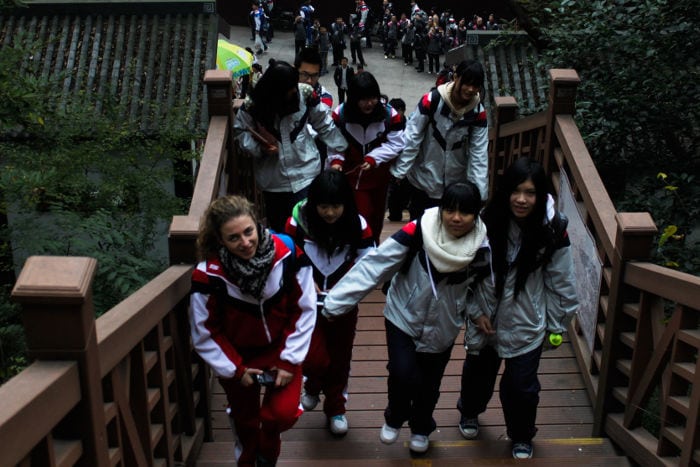 Climbing the Mount Xixia.
Dreaming of Beijing
How did you arrive to China?
I won a scholarship with AFS, a non-profit organization that promotes the mobility of the students through associations displaced in every continent.
Why did you choose China?
During my first year of high-school I had the possibility to participate to an experimental Chinese course. Keep in mind that till three years ago it was impossible to even find a textbook in Italian to study Chinese. But it worked and after two years we moved from two hours per week to five hours per week.
After two years of study I won a small scholarship through the HSK exam and I went ten days to Beiijng. And I loved it.
Since I already had the idea to do a year of high-school abroad, I reconsidered my priorities. Before I was thinking about Costa Rica, Chile, Ecuador, Argentina or Honduras.
Now I wanted to come back to China!
At the end I got a scholarship from the AFS program and here I am, in Nanjing, China.
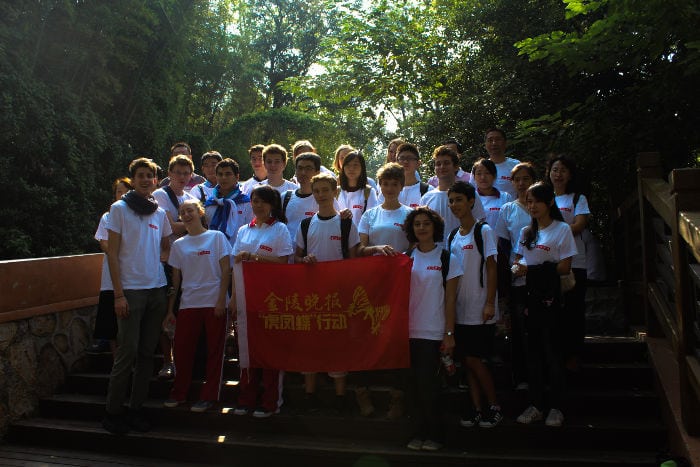 In Nanjing.
When did you land to China?
The stamp on my passport says 2012-08-24.
It was difficult to get used to the new situation?
From a practical point of view I did have some problems as “it’s midnight, I had dinner at five and now I’m starving.”
Also, at the beginning it was difficult to keep listening endless discussions that I couldn’t understand. You never know if you should insist with 没听懂 (I don’t understand),再说一遍 (Could you please repeat it?) or just nod and smile.
The other difficult part was to survive to the Saturday nights at home while I knew that all my friends in Italy were out partying. Those were the moments where I asked myself:
“Why the hell did I come here?”
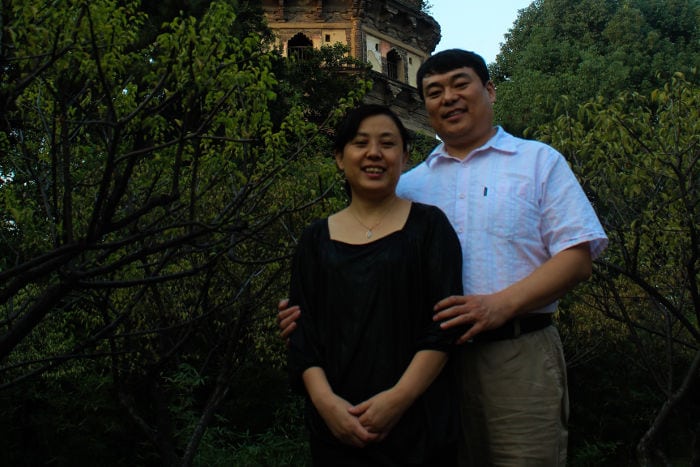 Marta is living with a Chinese family.
How is going now?
It’s getting better and better. I like my life here, maybe especially because I’m really living as a Chinese adolescent does (with the difference that they already speak Mandarin).
I would be hypocrite to say that everything is perfect. But I learned to think about the reasons for which I’m happy here and the bad moments go away quite fast.
[Furio: I agree. It’s a shame it took me 29 years to understand it and there are still so many people that don’t get it and keep complaining for every little problem].
How is living with a Chinese family? Any problem of communication? What about the food?
I never had all these attention. In China the mothers live to satisfy the necessities of their children. Even if my “sister” comes before than me, I still feel that I get more attention here than in Italy.
The problems arise when I try to live a bit more as a Western, when I can’t stay at home anymore and I try to go out. I must say that lately I’m getting used to it. On Saturday the curfew is still 9pm.
The biggest problem is my sister. We weren’t able to connect and she ignored me since day one. I learned to do the same with her.
Communication has never been a big problem. At the beginning my sister was helping me (she speaks decent English) while right now my Chinese got better and I can discuss in Mandarin with my mother.
 Marta with her “sister.”
I don’t have any problem with food. Up to know nobody treated me dog meat but I would like to try it. I’m curious!
How is the rapport with your classmates?
The first day of school, September the first, I felt as my classmates were interested but at the same time afraid by me. A bit as if they found a tiger in the classroom. They took a lot of photos but nobody came to talk with me.
However with the time things got better, they started to ask me a lot of questions. They all asked the same stuff but I was ok with that.
Nowadays I have a lot of friends and everybody is willing to show me around the town, teach me Chinese and so on.
A couple of days ago a girl told me “我不要让你回家” (I don’t want you to go back home), which made me think that right now I have a lot of friends here but next June I’ll have to leave China anyway. And I’ll miss them.
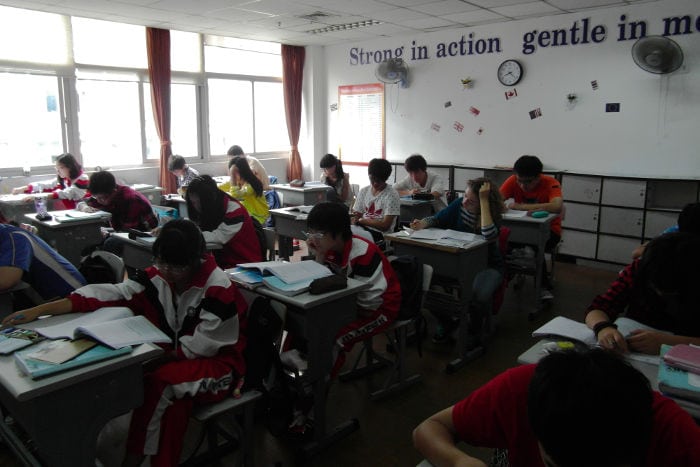 In the classroom.
What’s your favorite Chinese dish?
The 饺子 (jiaozi, the Chinese dumplings) made by my 妈妈 (mama). I must say that I also like the Beijing duck (北京烤鸭).
Do you like more Italian or Chinese guys?
Haha this is a difficult question!
I would say that “handsome” Chinese guys are more handsome than “handsome” Italian guys, if you get what I mean. However finding a handsome Chinese guy is much more difficult. In average I would say that I prefer Italian guys.
Moreover, the problem with Chinese people of my age is that for “love relationship” they just intend take each other hand in presence of other friends. They wouldn’t dare to go out alone because of the fear or getting caught.
Also, Chinese guys are too afraid to lose face with a Western girl. Hence they wouldn’t never ask me out. Even if the QQ zones (one of the Chinese “Facebook“) are full of my photos with a lot of sweet comments and it seems that two guys fought for my “love” (I wasn’t there though).
[Furio: Yup, it’s always a “face” problem].
Studying at the Chinese high-school
What’s your experience with the Chinese scholar system?
The scholar system here doesn’t allow students to express themselves. I’m not talking about becoming an artist or so. I refer to basic stuff. Since I’m here I’ve never heard a teacher asking “What do you think about that?” or “In your opinion this is right or wrong?” There is no way to express your opinion…
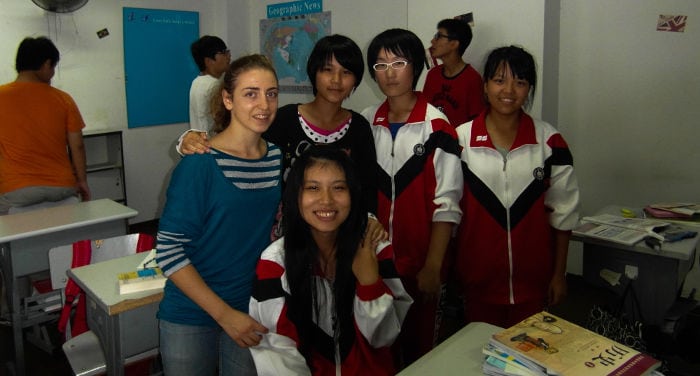 Marta and her classmates.
Studying in a Chinese high-school
Even if you were already studying Chinese in Italy, moving to a Chinese high-school has probably presented some difficult to you. Which are your biggest challenges?
I don’t know whether is a good or a bad thing. However here it works like that:
“You are a foreigner so you don’t have to follow all our rules.”
This is a good news as if I had to respect all the rules I would have already been punished or even expelled. In the same time it’s a bad news because, if I was obliged to do all the homework that the other students do, right now my Chinese would have been much better.
I spend a good part of my day studying Chinese on my desk. I also follow the English lessons (they are 95% in Chinese but they are easier to follow).
Another lesson that I like is chemistry, as I already know most of the things and I like the professor.
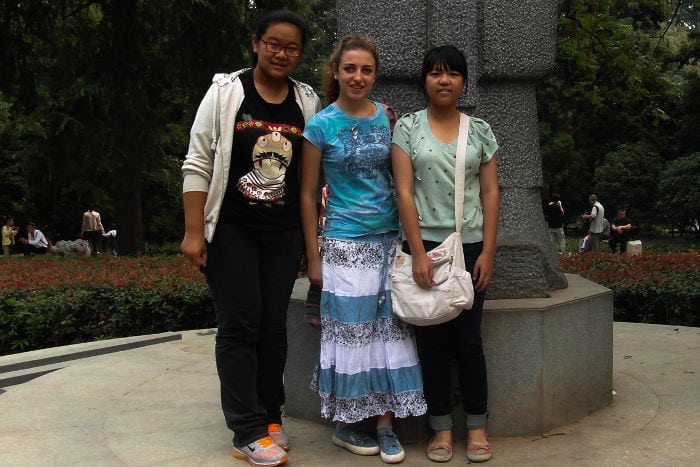 At the park with some friends.
What about the teachers?
The Chinese students are really afraid by the teachers. I often hear comments such as “I must study or the professor will get angry,” “I can’t do it or I’ll be punished” or “If they find me they will call my parents and I’m dead.”
Here you don’t study because “learn something” may be useful. You only study because someone else told you to do so, as if we still were at the primary school. If you arrive late you’ll have to spend one hour standing up and facing the wall. If you get a word wrong in a English dictation you’ll have to copy that word from 50 to 750 times (depending on the teacher).
I still have to understand what will happen when two students are discovered in a love relationship (my classmates talk about terrible punishments).
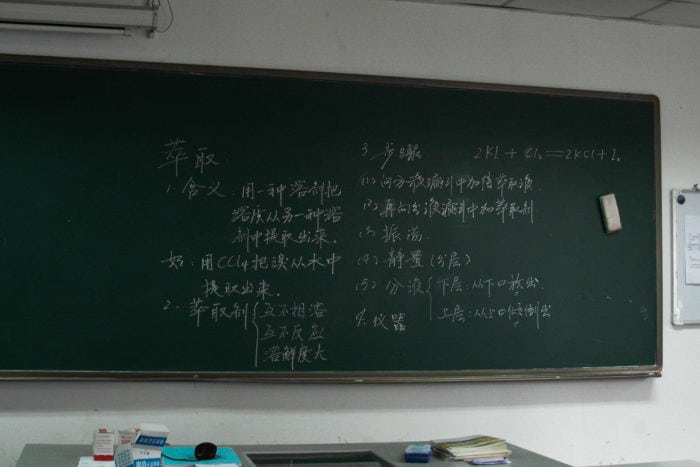 The blackboard.
In another hand the Chinese professors work a lot. They arrive at 6:45 in the morning with the students and leave after 6 p.m. Once per week they stay with the students that live at school and that have to stay in the classroom till 9 p.m.
Beside the working time, they check all homework within a day (even the ones given for punishment) and prepare tons of material (Powerpoint presentations and so on) for each lesson.
With respect to my rapport with the professors, some of them just pretend that I don’t exist. Others kind of acknowledge my presence and often ask me some questions as 是不是,越来越听懂? (Are you starting to understand more about the lesson?) or even allow me to actively participate to the lesson.
The typical day of a Chinese student
How is the typical day of a Chinese student?
A Chinese student arrives at school each morning at 6:45 and starts to clean the classroom. It’s not a difficult task but must be well-done as the professors will check it.
At 7 a.m. each student starts to review the lesson on his desk till when, at 7:15, the teacher enters the classroom and gives the first test to the students (usually about English vocabulary).
At 7:45 everybody goes out for the daily exercises. Before the drill each classroom has to shout out a slogan.
Then we listen to the national hymn, watch the flag-rising, listen to a discourse given by one of the professors and do a series of gym exercises. Then we come back to the classroom.
After lunch (at 11:45) we are obliged to take a nap. Usually I can’t sleep and I have to wait one hour to start again with the lesson.
The afternoon lessons last from 13:45 to 17:25 with a short interruption for more outdoor exercises.
After school we have to study from three to five hours, according the ability of each student and to the decision of the parents. The students that live at the dorms have to stay in the classroom till 21:30.
Each time that a member of the class makes a mistake or disobeys to an order, the whole class loses points. At the end of the week the best classes are granted with a star in a big blackboard (but I still don’t get what these stars mean).
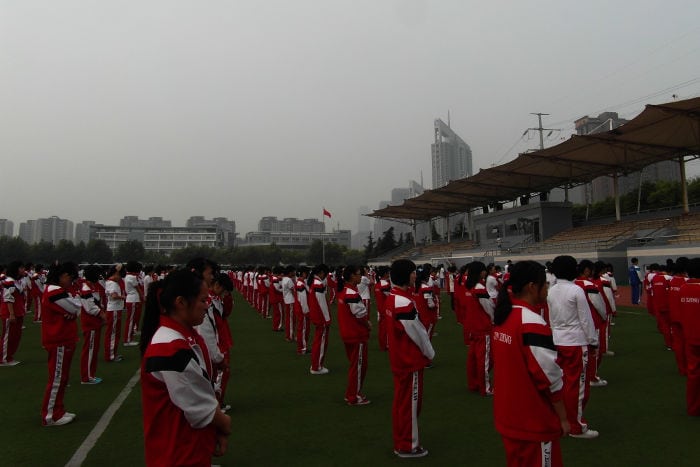 Exercising.
What kind of liberty have Chinese students?
The school and the families team up in order to control the Chinese students. After that a professor corrected a homework, he sends a personalized sms to the parents of each student with the marks of his son/daughter and the marks of the best student in the class (yes, you must compete with other students and try to be the best in China).
Another interesting point is concerned with the unjustified absences. If a student doesn’t come to school his parents have to call a professor. Conversely, the student will be punished.
But the control of the school is much more deeper than that.
The Chinese students can’t have a love relationship because this would disturb the main goal: get the final diploma. Girls can’t get a perm and guys can’t have long hairs. And so on… at the beginning of the year you get a small book that lists all the rules. I can tell you that they are a lot.
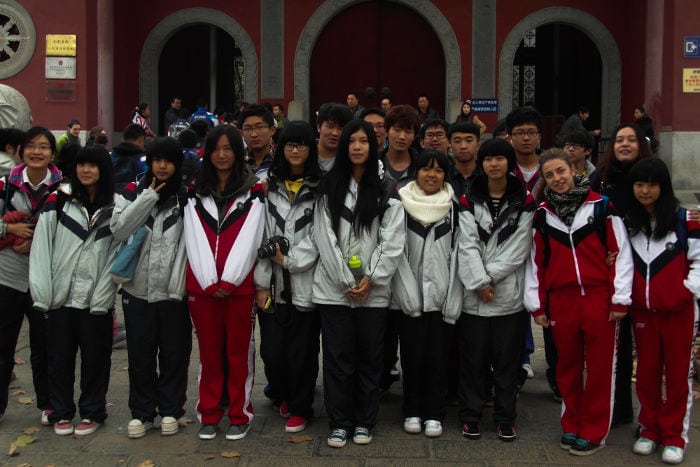 An excursion with the class.
Backstage
Marta, your story shows that nowadays Western students have the possibility to travel even when they are really young. I think that many people stay at home because they are afraid of what they don’t know, instead of because a real lack of resources. What’s your take on it?
I agree! Today it’s possible to create the conditions for traveling by ourselves. Of course staying at home and complaining while mom prepares our lunch and washes our clothes is easier. When you decide to leave you don’t really know what you’ll find.
But then you leave and you are overwhelmed by new adventures and emotions.
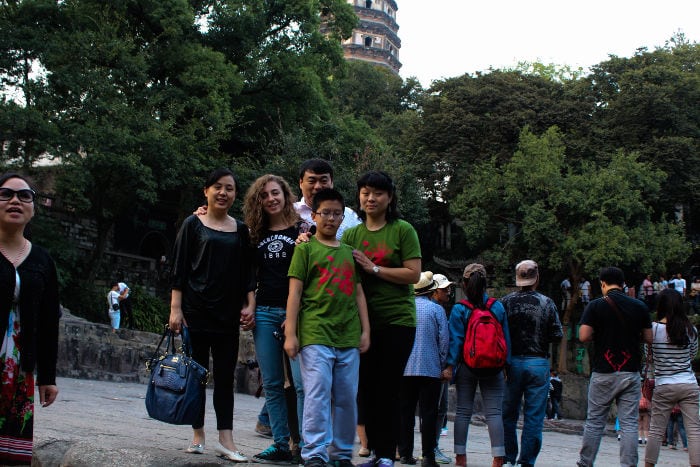 Vacation in Suzhou.
I know that I’m only sixteen. So maybe for me it’s easier to talk on this way. I didn’t have to give up too many things in order to come here. But I did have a good life in Italy: I was a good student, I was a decent gymnast, I had a ton of friends and a boyfriend. However I left anyway. And I believe that the experience was worth the effort.
Help me to debunk the myth that traveling is dangerous. Have you ever felt that you were on danger in China?
Yep, everyday when I cross the road : P
No, really, China is completely safe. In my experience much safer than Italy. And, considered my blond hair, I think it’s quite easy to see that I’m foreigner here.
Ofter the people that love us the most are also the ones that try to thwart our dreams. Sometimes they do it unconsciously, to protect us or because they fear that, if we travel, we will change (which is true). How was your experience?
Many people told me that I was crazy. The day before I left, my cousin claimed that this was the biggest mistake of my life. My grandmother even told me that Chinese people would have infected me with herpes. LoL!
But in general my friends were quite supportive. Also my parents reacted quite well. I think that it helped the fact that I didn’t wake up one day saying “Hey dad, tomorrow I’m going to China.” It was a slow process, so they had the time to “digest” my decision.
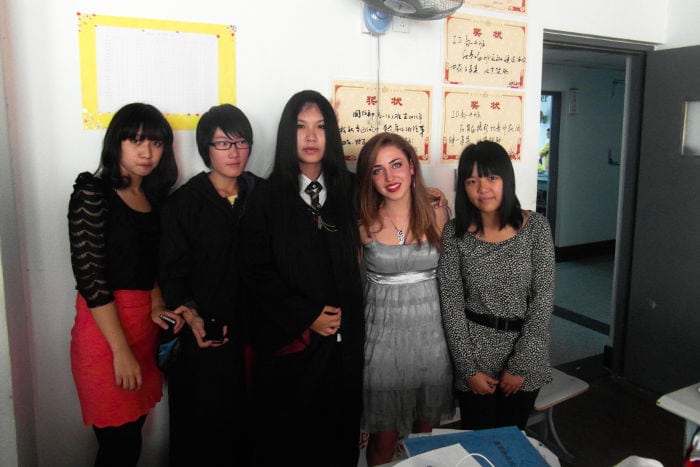 Halloween’s Party
What do you miss more about Europe?
Not that much. I miss going out at night, discuss about politics, eat pizza and ice cream, my gym and say hello with two kisses.
If you could come back to last year, would you still choose China?
Yes!
How this experience changed you?
I will answer to this question next year. At the moment I have no idea : P
Marta, thank you for your time. You seem a quite mature girl and I’m sure you’ll do well. How do they say in China? Ah yes, 加油!
Photo Credits: Photos by Marta Lovisolo




Pingback: Home Remodeling Contractors in Tucson
Pingback: Certified Financial Planner
Pingback: AI in Business
Hey
I am Hawi from Ethiopia , and am studying textile engineering under graduated in my country. But now I want to studying in China.please help me as I get this golden chance.
Hi,
you find a lot of articles in this topic, here at SDC, including one that go into details on scholarships
Is dog meat servedin Italy? ;-)
Marta – Congrats on your scholarship!
I hope the second portion of the article talks bout the Gao Kao (College Entrance Examination) I believe 16 year old may not be fully engaged in preparing but on the horizon. Or perhaps part 2 may talk about some cross cultural experiences that have come out from the experience and the impact on Marta’s classmates and host parents.
Cheers,
Hg
Hey Harley,
the second part will be online the day after tomorrow but don’t tell it to anybody : P
Furio
bella intervista Furio.
La ragazza è sicuramente di carattere e sa quel che vuole.
I agree with you : )
honoured to read this comment ;)