
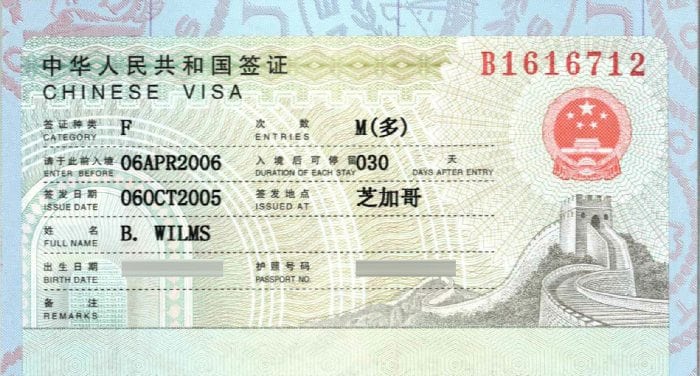
After publishing our comprehensive guide for obtaining a Chinese Visa, we received hundreds of questions and suggestions.
We updated the article several times based on the feedback and new laws. However, it appears that there is still a point that is unclear.
This article will explain what type of Visa you shall apply for and what documents you need when you want to visit (or accompany) your family members or friends in China.
 Effective March 15, 2023, China will resume issuing all types of visas. Travelers may be required to provide a negative Covid-19 test taken within 48 hours prior to departure, but quarantine will not be necessary upon arrival.
Differences between L, Q, and S Visa
There are three kinds of Visas that can be issued for visiting purposes: the L Visa (tourism), the S Visa (private affairs), and the Q Visa (family reunion).
This may be a bit confusing! In order to assess what Visa you shall apply for, you must look at the relationship (sister, friend, and so on) between you (that is the visitor) and the person you want to visit in China (that is the host). Moreover, you must take into account the legal status (Chinese citizen, foreigner with Chinese temporary resident permit, and so on) of the host in China.
Here are the details:
- Q Visa: Issued to family members (below you find the definition of “family member”) of Chinese citizens or foreigners with a permanent resident permit.
- S Visa: Issued to family members of foreigners with a temporary resident permit.
- L Visa: Issued to family members and friends of Chinese citizens or foreigners with a resident permit (however if you have a hotel booking you don’t need an invitation letter in order to get an L Visa).
Important: In order to be able to issue an invitation letter for you, your host should hold a resident permit (either temporary or permanent) or a Chinese passport. People that live in China with an M, F, L, X2, Z2, or J2 Visa can’t issue an invitation letter for you.
Notice that the definition of S Visa as “private affairs” leaves the door open to interpretation, and on some special occasions non-family members, such as unmarried couples, will also be able to apply.
Requirements for obtaining an L Visa
Beside the basic requirements (passport, photos, etc), you’ll also have to provide:
- An invitation letter: The invitation letter should contain your name, passport number, travel dates, itinerary, address, and your host’s name, passport and/or ID number, address in China, and telephone number.
- Copy of your host’s Passport and/or ID.
- Copy of your host’s resident permit (if he’s not a Chinese citizen).
- Copy of your host’s registration to the local police (if he’s not a Chinese citizen)
- Copy of your round-trip flight reservation (a round-trip ticket to/from Hong Kong or Macau is also accepted).
Important: Note that if you have a round-trip reservation AND a hotel booking for the whole duration of the trip (with the full names of all the people that will apply for the Visa and stay at the hotel with you) then you may apply for an L Visa without providing any additional documents (letter of invitation and so on).
The reason is that the L Visa is a standard touristic Visa. By presenting all the documents we mentioned above you won’t need any hotel reservations.
Definition of “family member”
The definition of “family member” depends on the type of Visa you’re applying for:
Q1 or S1 (long term, more than 180 days): A family member can only be your spouse, parent, parents-in-law, son, or daughter under the age of 18.
Q2 or S2 (short term, less than 180 days): Besides the previously mentioned relationship, a family member can also be your son or daughter 18+ years old, grandparent, grandson, granddaughter, or sibling.
Requirements for Q Visa and S Visa
Beside the basic requirements, you’ll also have to provide:
- A copy of the passport, registration to the local police, and/or resident permit of your family member (in case of a non-Chinese citizen) or a copy of the ID card (in the case of a Chinese citizen).
- An invitation letter from your family member indicating:
- Your personal data (name, passport number, address)
- Your family member’s personal data (name, contact, ID or passport number, address in China)
- general info about the visit (purpose, dates, relation between the host and you, itinerary, financial source for expenses)
Click on the following linka to download a sample of the invitation letter in English or Chinese.
- An original certificate (and a copy) that states the familiar relationship between you, that is the visitor, and the host (for instance a marriage certificate). Notice that additional documents or an interview might be required in order to prove your relationship.
How to transform my Q or S Visa into a resident permit
If you get a Q1 or S1 Visa you’ll have thirty days after entering China to change it to a resident permit (or the Visa will expire). Besides the basic requirements (passport, registration at the local police station, photos, and application form), you’ll have to provide:
- A copy of your family member’s passport or Chinese ID (and a copy of your family member’s resident permit in case of your family member isn’t a Chinese citizen).
- A proof of relationship issued by the Chinese government, authenticated by a Chinese consulate in the country where you got your Visa or issued by a foreign consulate in China.
The following additional documents might also be required:
- Depending on where you apply, you may need a copy of your family member’s unit business license, an enterprise code certificate (组织机构代码证), an official invitation letter. Click here to download sample invitation letter.
- If you entered China with a different Visa than a Q1 or S1 Visa, you may need a letter from your family member as a guarantee for your economical independence and compliance with Chinese laws. Notice that this is an “exceptional” situation: if you entered China with a different type of Visa, it will be difficult to get a resident permit.
Important: you must require your resident permit at the PSB (that is the Public Security Bureau) where your family member has its residence (hukou or local police registration). As an example, if your family member’s hukou is in Hubei province, it doesn’t matter if both of you live in Shanghai: you must apply in Hubei.
How to apply for an S or Q Visa if my partner isn’t living in China yet
- Q visa: The law isn’t clear whether a “family member” of a Chinese citizen that lives outside China can apply for a Q visa or not. However, in our experience, you can easily get a Q2 visa showing a marriage certificate and a Chinese citizen ID. Additional documents such as financial proof or a work contract might be required for a Q1 visa.
- S visa: You can apply for an S Visa at the same time as your family member is applying for the X1 or Z1 Visa (long term student and work Visa, respectively). The requirements are the same; the only difference is that, instead of the resident permit, you’ll have to provide a copy of all the documents of your family member’s Visa application.
How to apply for an S visa (for unmarried people)
Most Chinese laws offer a lot of space for interpretation in order to be adapted to specific circumstances. In this sense, Visa laws aren’t an exception. The S1 Visa normative states the following:
“Issued to those who intend to go to China to visit the foreigners working or studying in China to whom they are spouses, parents, sons or daughters under the age of 18 or parents-in-law, or to those who intend to go to China for other private affairs”
This vague definition allows certain flexibility to whom can apply. If you want to get an S Visa with your unmarried partner you should be in one of these two situations:
- Unmarried couples that have a biological son or daughter in common.
- Unmarried couples that have a relationship certificate indicating the partners live together as they were a married couple.
Important: Especially in the second case, the PSB or consulate officer will decide whether grant you a Visa or not case by case and at its sole discretion. Also, the rules might be different depending on where you apply and on the Visa owned by your partner.
Notice that same-sex partners with a marriage certificate might also be allowed to apply for an S Visa. Again, it depends on the circumstances.
I hope you found this article useful! If you have any questions or you want to share your experience you can leave a comment in the section below.
Photo Credits:  Chinese Visa by Brett Wilms






Pingback: ยา PEP
Pingback: บาคาร่าเกาหลี