
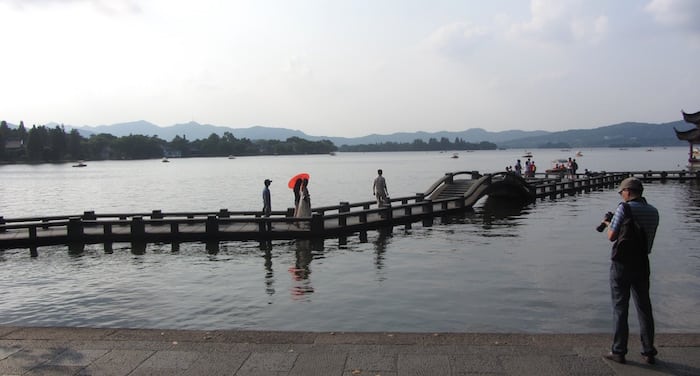
 Hangzhou’s West Lake
Close to Shanghai and the sea, headquarters of the Zhejiang region, Hangzhou is a special city for its physiognomy, nature and history. The first time I stepped foot here, even the gentle ways of the inhabitants won me over .
It would seem that, despite the size and proximity to major centers, the fevered rhythms of Shanghai and the exuberance of Nanjing they don’t belong to this city, which has lived for millenniums along the shores of its lakes and is surrounded by temples and hills.
Today it is most famous because it is the home of the giant Alibaba (as if it were the Mountain View of China), of which Mr. Jack Ma continues to be in the top fifty of the world’s billionaires; or, because in 2016 it is here that the G20 took place, the last important such appointment between Obama and Xi Jinping, before his departure from the White House.
But much earlier than them, Hangzhou was one of Mao’s favorite places, and even Marco Polo was rather struck by it. Moreover, you have to know that i imagining the typical, almost stereotypical Chinese landscape with a little lake, sweet hills that embrace the water and pagodas that dominate the horizon, you may not know it, but its most likely that you’re thinking of Hangzhou’s West Lake (西湖). Even if you’ve never been there.
Nothing here is left to chance and the panorama of this corner of Hangzhou was specifically designed to be unforgettable. If you happen to find yourself in this beautiful place for even one day, don’t miss the chance to check out its aquatic heart. Hangzhou deserves a longer stay, but nothing that you’ll see could surpass the poetry of West Lake.
Hangzhou inside your itinerary
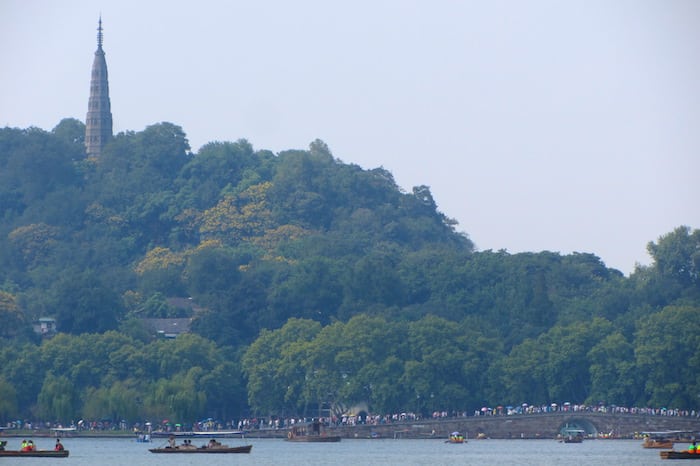 Pagoda Baoshi and Bai Causeway
Hangzhou is located in reach of other famous places and is crossed by high speed lines, which automatically makes it a convenient destination. So, in short:
- Shanghai is less than an hour away by fast train. From Hongqiao station trains leave about every fifteen minutes.
- From Nanjing it will take an hour and a half, and since almost all trains going to Hangzhou are on the line that connects Nanjing to Shanghai, their frequency is the same as above.
- The smaller but highly-visited Suzhou is equally as reachable in an hour and a half.
- From the capital Beijing, the trip takes about five hours with the G19, and about six hours with the other thirteen daily trains; some opt to take a flight, but unless you’re in a hurry, I always recommend the train which normally don’t run late!
- Incredible but true, you can reach China’s other chief city, Guangzhou, by fast train: in six hours the G86 arrives at its destination; besides that, there are three other runs during the day.
Other destinations are obviously served by domestic flights. A wise alternative in planning your complete itinerary could be to evaluate making a stop in Hangzhou rather than the usual connection to Shanghai. Airport delays in Shanghai are known to be quite agonizing. Moreover, as was mentioned, the city is well-connected to the large metropolises so the total effort of moving between airports and stations, is highly optimized.
In any case, Hangzhou will certainly be in among one of your stops during your travels in China, and for this you can’t ignore it!
How to get there
Hangzhou is served by high speed train and international flights. The Hangzhou Xiaoshan International Airport can be reached directly from the majority of European (Amsterdam, Frankfurt, Madrid, Paris, Rome, etc.) and American hubs (Los Angeles, Vancuber, etc.).
You can also choose to fly into one of China’s main cities such as Beijing, Shanghai or Guangzhou, and get to Hangzhou on an internal flight (and these are numerous, and from all over). Asia is generally well-connected; there are among others, flights from Taiwan, Japan, Korea and even Vietnam.
Note that it’s also possible to fly to Shanghai Pudong: for a transfer toward Hangzhou you should then consider getting to the Hongqiao high speed stationwhich is on the other side of the city (an hour and a half by metro, or seven minutes on the Maglev and an hour on the metro, or an hour and fifteen minutes on a shuttle bus).
Otherwise there’s a comfortable long distance bus service inside the airport, that for the sum of 100 Yuan will take you to Hangzhou in 3 hours. It runs between 8.40 in the morning and 9 in the evening.
From Xiaoshan Airport, the quickest way to get to the center are the shuttle buses, that will bring you to the station for 20 Yuan and allow you to connect to the metro, bus lines and taxis; or take a taxi directly from the airport that will take you where you want to go for (about) 130 Yuan. The airport is connected by bus to other destinations in Zhejiang or Jiangsu as well, such as Suzhou. You can find the timetables and destinations with this link.
The high speed train station, instead, is connected by lines 1 and 4, and buses K7 and Y2 via Beishan Lu up to Lingyin Temple. You’ll be blown away by the size of the station, it is one of the largest solar-powered buildings in China!
When to go
Hangzhou is affected in one part by the humid climate widespread in the interior of the Yangtzi Delta region, and on the other by its proximity to the sea. You won’t find the ferocious humidity of Nanking or Suzhou, and the winters are relatively mild. Hangzhou is most visited in April and May, while June and July are particularly rainy. Autumn is colder compared to the Spring, it’s chillier especially along the lake, so dress warmly. Obviously, the surrounding hills come alive with color in Spring and Autumn, and for this reason these are the periods most recommended for visiting the city.
Why go
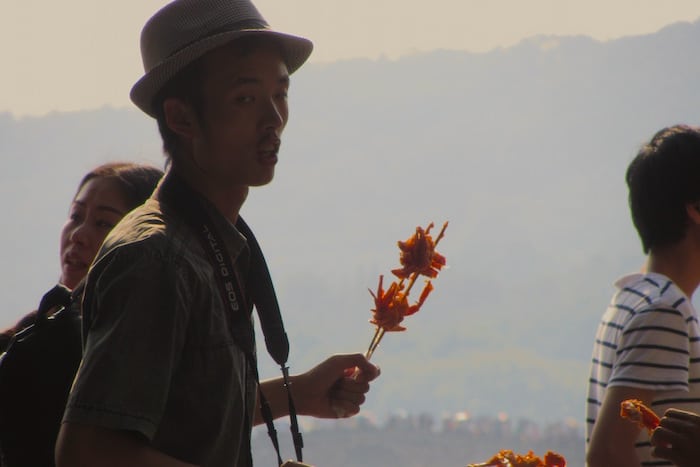 Crab snacks on a walk
The usual recommendation applies: since this is an easy and well-serviced destination, usually during the Chinese holidays, the city is overtaken by tourists. Sure, they’re more than a billion, it’s easy for them to descend on local destinations. It’s not the level of Beijing and Xiamen, but I can assure you that it isn’t possible to make out the lake over the heads of all the passing tourists. Normally, I’d recommend you avoid the crowds; but I enjoyed myself so much experiencing the special vitality of Hangzhou. So when you go, throw yourself into the fray!
Hangzhou was the first city in China where I saw cars stop spontaneously to allow pedestrians to cross at the crosswalks (yes, you heard me: so I saved your life…!). The first city where I came across large kites, maneuvered by old wise men, flying so high as to seem like real birds. The first city where there are more bikes than electric mopeds. But also the first city where I saw Mao’s face waving with pride and confidence.
Moreover, along the shores of the lake from sunset to evening, all sorts of activities typical of Chinese squares unfold: dancing as groups and couples, karaoke singing, choruses. But even cards, majiang… Then there’s the trendy part, which can compete with Xintiandi of Shanghai, and is called in fact Xihu Tiandi (西湖天地去). During the days I spent in Hangzhou I ate brick oven pizza, listened to jazz from a black muse, climbed rocks a meter and a half high as if they were sixth level walls, ate crystallized fried crabs and slept on the couches of Costa Coffee without anyone chasing me away. Besides, this is the China that we like, right?
How to get around
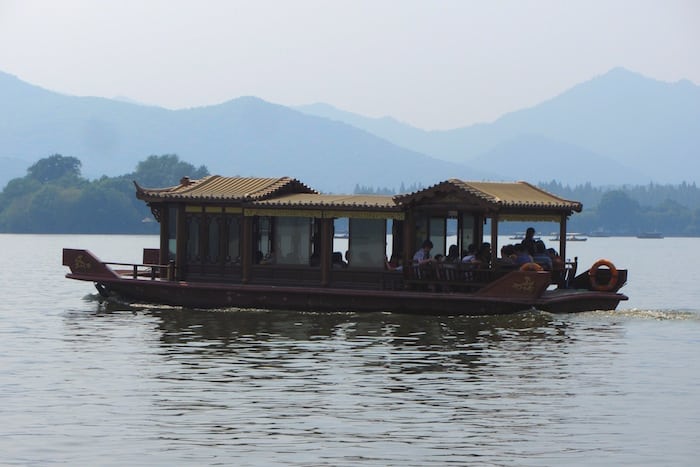 The boats of West Lake
Hangzhou deserves a special section dedicated to transport because, unusually (at least for China), this city is married to the bicycle. Tourism on two wheels is one of the smartest choices if you like to pedal and want to visit the areas around the lake, which are equipped with cycling trails. Like in other cities, here too there are public bicycle rental services, but to use them you have to have an IC card or Z card.
You can get them at service centers for 300 Yuan (200 Yuan are security, 100 Yuan for “traffic”). The main service centers are found at Ding An Lu 25-1 (公共自行车客户服务中心 – 定安路25-1号) near the metro of the same name; nevertheless near the lake there are other offices, such as at the entrance of the Youth Palace (青少年宫), at Wushan Square (吴山广场) and the entrance to Liulangwenying Park (柳浪闻莺). In any case, you’ll find about 50 offices spread around the city, so ask at your hotel for the closest one.
The minimum limits for rentals are 12 years old and a height of 145 cm. Bicycles are not for use at night, and if you try to attach one unsuccessfully after 21.30, you’ll have to bring it to the Longxiang Bridge service center (龙翔桥). The prices are ridiculous: the first hour is free, the second is 1 Yuan, the third hour is 2 Yuan and the fourth is 4 Yuan increasing by 3 Yuan an hour after the fifth.
If however you’re traveling as a couple, you can choose to ride close to your partner (or completely abstain from doing so :-P ) by renting a tandem; at the time of my trip, they were made of yellow iron still wrapped in plastic, which gave the impression that they would be anything but comfortable. But it’s the most suited for taking in the scenery in company. There are also version for three!
The IC card for bicycles is also valid on public transportation. To indicate the buses of line Y, which are those for tourists, they are also labeled in English; perhaps you might use line Y1 which is the circle line, in the sense that it goes around the lake and ends up at the Lingyin Temple (灵隐寺); or the Y2 from the station.
Only two metro lines are currently working, the 1 and the 4. Soon the 2 should start running, to be followed by other numbers up to 10. For now it’s easier to count… on taxis! Which in China are still very cheap and widely available. A few years ago I had serious difficulty finding one on a few occasions during my stay in Hangzhou, which is why I then opted for getting around by bus and bicycle. Surely the situation has changed.
For getting around on the water there’s obviously boats. There are the old-style rowboats available (6 places) which are limited to the north section of the lake, or the eco-friendly electric ones. There are also ferries, populated by much cheaper groups, where the tranquillity is left upon boarding. The price for boat tours is usually around 50-70 Yuan a person.
By boat you can also get to Suzhou from Hangzhou. The trip along the canals is usually overnight, departing towards 17 and getting in at around 7, for relatively moderate prices (70-150 Yuan), but it’s good to check first at your hotel because continuous service isn’t guaranteedo.
What to see
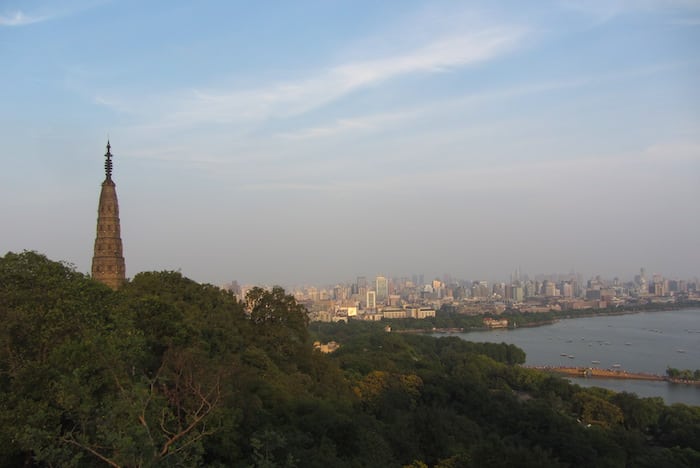 View of the city from Baoshi Hill
Xihu and around
In Hangzhou there pulses a central soul, which is the main wonder, or West Lake, Xihu. Around the lake are various attractions, all perfectly organized and reachable.
You can take a tour around the lake on bike as was mentioned above, or take advantage of the golf cars (you can buy tickets near the Causeway of Su and Bai or the Leifeng Pagoda); it’s not a solution just for laziness, but also great for nature-lovers since it offers amazing walks. Or still with the tourist buses Y1 and Y2. By foot it will take between 3 to 4 hours to walk the perimeter.
The biggest of the islands of Xihu, Gushan (孤山倒), is connected to its shores by Causeway Bai (Baidi, 白地) a pleasant raised roadway that’s enchanting in winter when covered with snow. It was built by this poet and governor, which soon came to be imitated by Su Dongpo with the Causeway Su (苏堤) that connects the northern shore of the lake with the south and is always walkable. Inlaid with arched bridges, Huagang Park (花港公园) crosses towards the southern part.
But returning to Gushan Island, it hosts different architecture of interest, but I’ll only mention The Zhejiang Provincial Museum (浙江省博物馆) and Zhongshan Park (中山公园).
On the north shore that faces the island, you’ll find a nice walk up the hill that you can choose to make on the path of stairways or along the slopes; keep an eye out, this isn’t an official trail and isn’t marked (the CAI has not yet provided it…) so you should find it on your own. On top you’ll find Baoshi Pagoda (宝石塔) where you can admire a beautiful view over the city and lake. If you come at sunset, you’ll most likely find white collar workers that hop from one rock to another so as to do a little physical activity after work. A type of free climbing but with much more modest heights.
Since we’re talking about pagodas, on the opposite shore, you can climb to the top of Leifeng Pagoda (雷峰塔) to compare the panorama.
Completing the tour of the lake, still in the north, there’s the Mausoleum of General Yue Fei (岳飞墓) that commemorates the history of this unfortunate history and Quyuan Park (曲院风荷). This shore is definitely the most interesting. The other sides face lesser attractions, with the exception of the West Lake Museum (西湖博物馆) where you’ll find everything on the splendid Hangzhou Lake, even in English (it’s free and closes at 17).
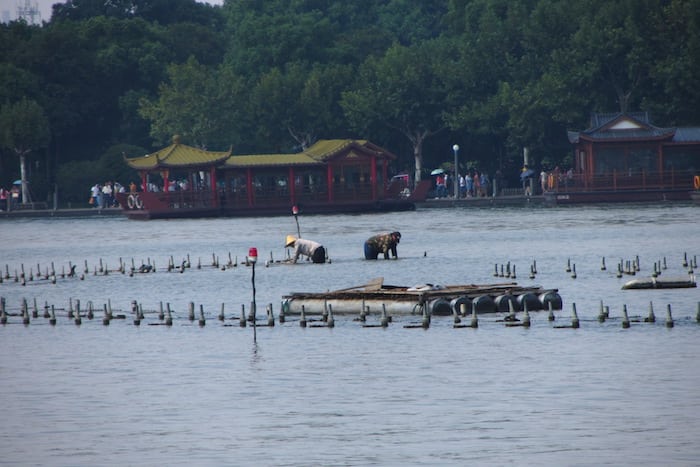 Fishermen…maybe
The other three little islands can be discovered only by boat, and are Ruangongdun Island (阮公墩环碧), the Huxin Pavilion (湖心亭) and Xiaoying Island (小瀛洲). This island is famous because from here you can admire Santanyinyue (三潭印月), in other words the “Three Little Lakes that Reflect the Moon” and ask why they have such complex names…
Only the lake will take more than a day if you’d like to carefully explore it between the water and the shore. If you’d like to see it on your own, I suggest you get yourself a detailed map with pathways and all the attractions (some of which can be skipped, I must say), with the tourism office or the museums. Even the hotels usually have them available (I stayed at the YMCA and didn’t have any trouble tracking down the material).
Parks and gardens
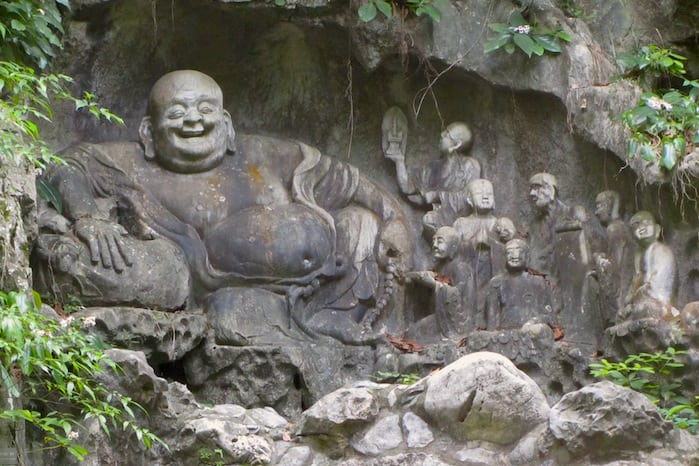 Feilafeng
Hangzhou is an extremely green city and the town dedicates a lot of its resources on its attractions. Parks and gardens – first of all those already mentioned – Zhongshan, Quyuan Park and Huagang Park – are very well tended.
To the northwest there’s a discreet botanical garden (Zhiwuyuan 植物园) and continuing towards the south toward Causeway Yang, you’ll come across a private villa, Fenyang (汾阳别墅), whose garden will remind you of its cousins in Suzhou. Like Fenyang, Villa Guo (郭庄) has in its garden, and its relationship with the water, as its strong point.
Nevertheless, what is most noteworthy is located a little out of the vital center of the lake, toward the west. On one hand we find Feilaifeng Park (飞来峰) and further to the west, Xixi National Park. For both you’ll have to count on at least half a day, because they are extensive and require a slow, and in theory, silent rhythms.
Feilaifeng Park includes six temples and more than 300 Buddhas carved into the rock. It is all surrounded by flora and fauna that belongs to another China, certainly not the large metropolises of cement. Not far from there is Lingyinsi Temple (灵隐寺), one of the largest sacred Buddhist sites in China. To conclude your visit you can choose the stairs or cable car to get to the top of Bei Gaofeng (北高峰) where you can enjoy yet another panorama of Hangzhou from above.
Xixi National Park, also called Xixi National Wetland Park, is an area of 10 square km where, as the name says, the water is one with the land. The marsh, the river, and the vegetation and fauna that live there, are preserved and preferably observed by boat.
Talking about boats, obviously Hangzhou is the seat of an important Dragon boat race, which takes place every year in June, the Duanwu Jie (端午节). It is celebrated in various cities in China provided that there’s water and is a typical regatta that takes place aboard dragon shaped boats: multi-seated canoes where the rowers row from the side to the rhythm of a drum. The park is home to the Hangzhou regatta.
Museums
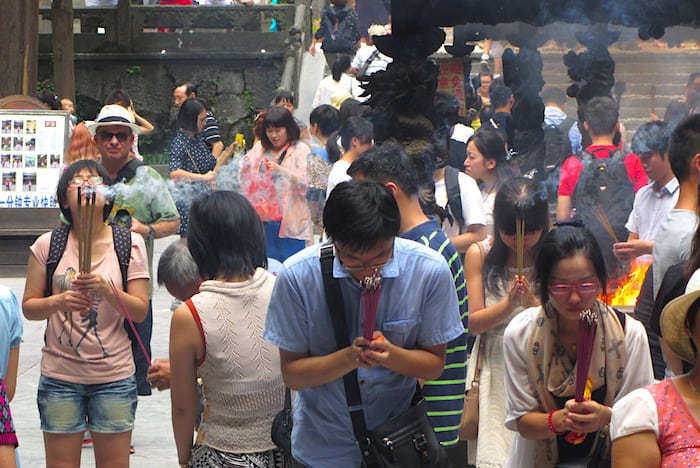 Prayers at Lingyin Temple
Hangzhou boasts some items of local pride for which it couldn’t help but arrange to be exhibited in museums: namely silk, tea and the already mentioned lake. The Silk Museum (丝绸博物馆) is an imposing structure that recounts the history and production techniques; being relatively modern, the museum is equipped with captions in English and the museum displays are well cared-for (and extensive, spread out as frequently happens across ample spaces that are almost excessive).
Regarding the Tea Museum (中国茶叶博物馆) you should know that it’s thanks to the cultivation of the Longjing specialty, the “dragon’s pit”, for which Hangzhou is famous. The museum extends across an ample area where the cultivation takes place and is defined as the so-called tea village (龙井问茶), where obviously you could taste and buy some.
Honestly, every place in China has its own quality of tea, and boasts of its uniqueness or importance that makes it superior to other parts of China. The experiences with tea, whether they be ceremonies, tastings or museums are all rather similar to each other, especially if you don’t understand a whole lot and the tasting has a limited effect on your taste buds – the notorious “corking” of wines, to explain.
Nevertheless Hangzhou is one of the best occasions for looking into this curious universe: first of all because longjing is one of the most expensive green teas, and in second place because the Hangzhou research center is one of the most serious. So take advantage of the fact that the museum is free, (NB: like the one for the silk!) and particularly complete, this could be the chance to go further!
At the end of this section all that remains is to mention the Museum of Chinese Medicine (中药博物馆) which rises up next to the Huqingyu Pharmacy (胡庆钰堂). It is an interesting visit, I admit, even if it is a bit commercialized. You can get a check-up from the onsite practicians.
Lastly, I like to remember how this unusual city was and is a land of religions. There’s a Catholic church (Tianzhu, 天主堂), a protestant church (Sicheng, 思澄堂) and a mosque (Fenghuang, 凤凰寺). Mosques, in this part of China, are not so common. Besides Hangzhou, only Guangzhou, Yangzhou and Quanzhou have one.
Where to stay
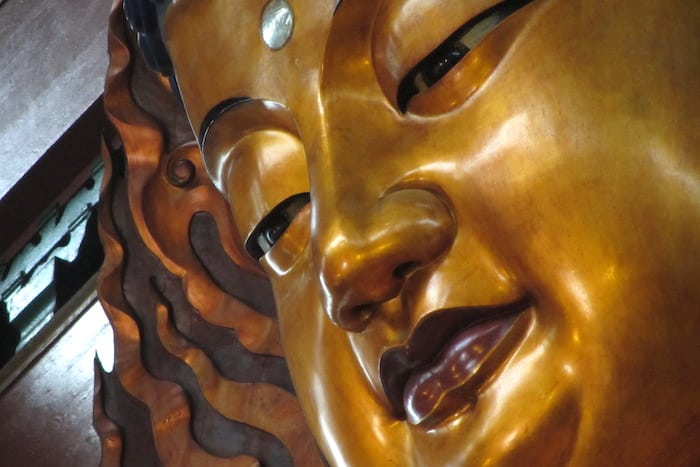 The Buddha at Lingyin Temple
The most obvious solution if you’re visiting Hangzhou for the first time is to stay in the city center, the area between the station and the lake. That’s where you’ll find the cheapest options. Nevertheless, for a stay that’s immersed in the fascination of the lake both day and night, obviously I’d recommend the shoreline the hotels that face the banks of Xihu. To the north, against the Baoshi Pagoda hill, are other hotels in an exquisite position but a bit out of the way from the boats and other things to see.
It is important to stay in the center to be sure that once night falls, after having walked or pedaled all day long, you (and your partner, or your family and kids!!) won’t have to take public transport just to get to a shower. Sure you can get everywhere by public transportation, but don’t count on the metro because the network isn’t sufficiently developed yet.
Here you’ll find a list of the hotels we recommend in Hangzhou.
I’ve already amply illustrated how Hangzhou was a city of many of my “first times”. Even when it comes to accommodation I can boast a first. I discovered only with time that in reality, what in that seemed absurd at the moment, in China happens quite frequently.
My husband and I (fortunately not a friend…!) spent the night at the Hangzhou YMCA International Youth Hostel.
The double room was listed as having “a bathroom in the room” but really it was more like having a room in the bathroom! The services were separated by just a curtain, making the simple use of the toilet an enormous test of trust between partners. We took turns, with one seated…on one hand, and the other seated on the steps outside the room. Patiently waiting. Let each person independently choose how to manage.
In China you’ll frequently find the bathrooms blandly divided off of the sleeping quarters: usually it’s just a wall of glass. Actually, some luxury hotels find it really chic to plant the tub in the middle of the space! To tell the truth, having the shower curtain intimately embrace the water has only happened to me there!
Shopping and night life
What should you buy in Hangzhou? Silk; but some might say, Suzhou is better. But in Hangzhou you’ll find a famous market located in Xinhua Lu (新华路217号), where you can not only buy finished products, but also cuts of high quality silk.
What are other typical products? Scissors and umbrellas. And obviously tea, but strictly longjing and strictly certified.
An event not to miss is the Wushan Lu night market (吴山路夜市): just as the name says…it’s no longer at Wushan Lu! But very close, so don’t worry. Walk a part of Huixing Lu (惠兴路) and then turn at Renhe Lu (仁和路). Metro stop: Longxiangqiao or the Jingtingqiao bus stop. Other shopping streets are Hefang Jie (河坊街) and Gaoyin Jie (高银街).
Regarding nighttime escapades, I recommend the Xihu Tiandi area and the west shore of the lake, where I found Eudora Station, but walking the neighborhood there are clubs for all tastes. Or to the north, Maya Bar is popular with Westerners.
Alternately, for those looking for entertainment for young and old, a classic of Chinese water localities is the water show (yes, yes, like in Guilin!): Night of West Lake. The show is put on every day at 19 and lasts an hour; check with your hotel for buying tickets because the price of tickets vary widely. They go between 80 and 300 Yuan! Children under 1.2 mt. pay half. Be careful in the winter because it’s all outside.
Around Hangzhou
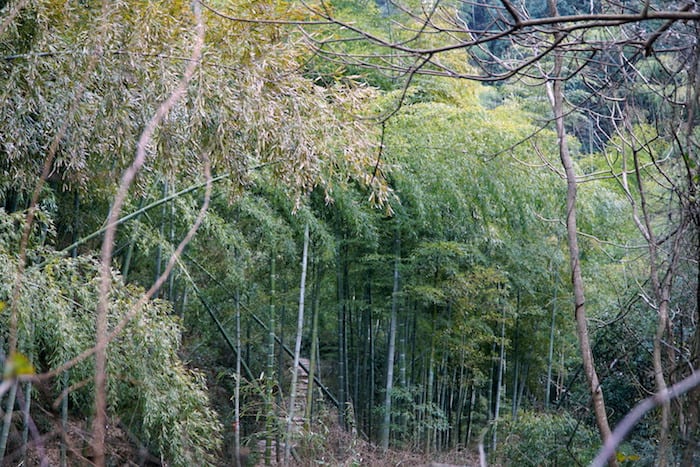 Moganshan
Situated outside the city, along the Qiantang River, the Pagoda of the Six Harmonies (六和塔) offers a beautiful view of the river. It is said that it’s magically capable of stopping the tide that increases the river’s level by six meters and gets up to 40km/h. The phenomenon draws many tourists and avid photographers.
The tidal phenomenon on the Qiantang River (钱塘江大潮) can be observed just about everywhere on the river and during the entire year depending on the lunar phases; nevertheless there is a Festival of the Observation of the Tide, if you want to get technical. The passage of the tide can be checked on Hangzhou’s weather site , which is in Chinese, but the numbers can be understood all the same.
Or check with the Hangzhou Tourism Office or directly at the hotel to have precise indications. The best spots are Haining (海宁) Yanguan city(盐宫) and Yaoshan (萧山). The festival coincides with the eighteenth day of the eighth month of the lunar calendar, so with the Chinese Mid-Autumn Festival.
Keep in mind that this is a large wave that arrives up the river with a large roar, and in certain places with notable speed; you’ll be surrounded by lots of Chinese that bend over backwards to get the first row, some winding up knowingly being drenched.
The tour of the Grand Canal starting in Hangzhou, where you can cross over to the Pagoda of the Six Harmonies or the ancient village of Tangqi (塘栖古镇) is increasingly quoted.
Despite the four hours of navigation to keep in mind, the trip is worth it because there are various buildings of original material, at least until the humidity or modernity signal the end. Expect similar scenery to other Chinese water cities, only smaller. Enchanting in the evening, despite the waste of light. If you’re interested, the embarkation at Wulin Square is your reference point; if you suffer from seasickness, there are various bus lines. Ah, for Tangqi an entrance ticket is included.
After having adventured in Hangzhou, you’ll want to complete the tour of the cities built on water. Take a look then at this Taste of China guide on Venices of the East: Suzhou, Zhouzhuang and Tongli. Conveniently located by train or long distance bus, they are an excellent way for a complete look at the Yangtzi Delta. In fact, if in Hangzhou you get the impression that it’s a big city, one that Suzhou attempts to imitate, then Zhouzhuang and Tongli have a decisively greater appeal of little towns of times past.
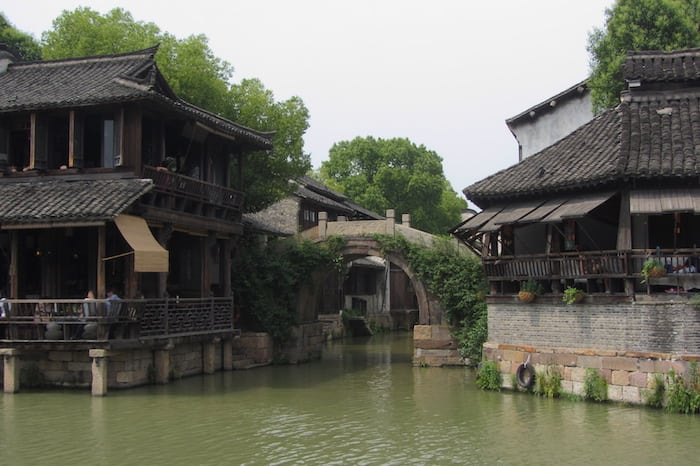 Wuzhen
A 90 km from Hangzhou there’s the picturesque village of Wuzhen (乌镇). Like the other destinations mentioned above, Wuzhen is inlaid with little bridges that cross the canals that face the buildings of the time. Or at least they maintain the architecture of the time.
There’s a paid entrance to the village, 150 Yuan for the combination ticket, since the village is divided into two parts, East and West. Besides losing yourself in the walks, you could also watch the old trades still being plied and small interesting museums. At night there’s the light show in the western part.
From Hangzhou the village can only be reached via bus, which leaves from the East bus station; you can choose an organized tour or public transportation. I recommend that you if you stay there a few hours, once you reach Wuzhen, to go on to Nanxun (南浔), which is only 20 km from there. It’s a visit of the same style, with a few buildings that are distinguishable with care. There’s a bus that conveniently connects two villages.
Another tour around Hangzhou (but really also Shanghai), is Moganshan (莫干山). In China they tend to define as a shan 山, mountain, even the hills studded with tea fields and bamboo forests.
Moganshan is of the second type. Here, hike on barely marked trails, often shrouded in fog and participate in organized activities that range from yoga to bike tours. It is a typical weekend getaway from the sultry city during the summer and one of the many holiday destinations for those who can’t fly anywhere else.
Chang Kai-Shek and his bitter rival Mao both loved this area, and is for this reason perhaps that it has remained so popular even today. There are some villages to see, very pleasant accommodations that have been renovated for those with fuller pockets. Moganshan has been for a long time the home of Mark Kitto, author of China Cuckoo, who decided to spend his life on these slopes.
If you’re fortunate, you’ll find him at the Moganshan Lodge is an inestimable source of information. Bring your copy for an autograph!
Have a good trip!
Photo Credits: Photos by Rita Andreetti



Pingback: www.piffbarcart.us
Pingback: ศูนย์รับแปลภาษา
Pingback: เว็บตรงฝากถอนง่าย
Pingback: บริการวีซ่าเชงเก้น
Pingback: แทงบอลเกาหลี
Hi and thank you for your extremely useful article!
I am currently studying in Xi’An and I’m planning to visit Hangzhou for the Dragon Boat Festival holidays (27-30 May). Do you know anything about the celebrations in Hangzhou? I’m afraid it might be too crowded; do you think it would still be worth it or should I choose another destination? How many days would you recommend to visit Hangzhou?
Thanks in advance!
Hello Giulia,
I think you will be ok! The West Lake may be a bit crowdy though!
I think 2 days is perfect for Hangzhou